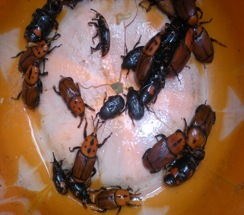
Pest Name :  Red palm weevil


Rhynchophorus ferrugineous Oliver


It occurs in all the coconut growing regions of the country.


Red palm weevil is a destructive pest in coconut plantation. This pest affects the palms during early periods of growth (below 20 years). Adult beetles lay eggs in the soft tissues in the cut or injured portions and the emerging grubs tunnel into the stem and feeds on the tender tissues inside the palm. Rhinoceros beetle damage and budrot / leafrot incidence predisposes the palm to red palm weevil attack.

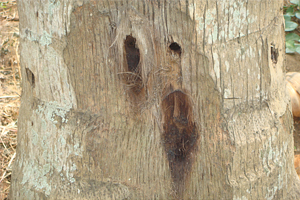
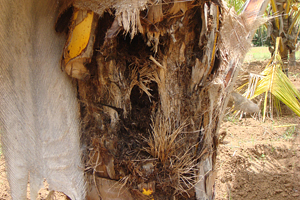
Usually the damage symptom is visible in the advanced stage of pest infestation. However, close monitoring enables to view the symptom in early stages too. Yellowing and wilting of the inner and middle whorl of leaves, small circular holes on the palm trunk with oozing out of a brown viscous fluid, longitudinal splitting of leaf base and presence of cocoon/chewed up fibers at the base of affected palm are the major symptoms of red weevil infestation.


  • Maintenance of field sanitation by removal, splitting and burning of dead palms, which harbour various stages of the pest, helps a lot in reducing fresh incidence and hence should be considered as an important step in IPM.
  • Fermenting smell emanating from the injured portions of the palm attract the weevils for egg laying. This can be prevented by avoiding injuries on the palm and by treating the wounds, if any, with coal tar.
  • Whenever leaves are cut, a petiole length of 1.2m should be retained on the palm to prevent the entry of the pest through the cut petiole.
  • Prophylactic leaf axil filling should be done to ward off rhinoceros beetle.
  • Timely fungicidal treatment for bud rot and leaf rot also is essential.
  • Trapping the floating population of weevils with log traps treated with fermented toddy is also recommended. Fresh coconut logs (50 cm long and split longitudinally), cut surfaces of which are treated with fermenting toddy are placed one above the other to serve as an effective trap for red weevil.
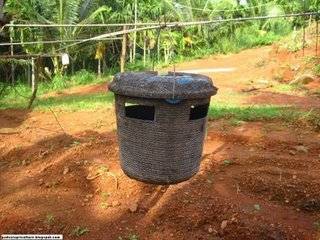
  • Trapping of red palm weevil using aggregation pheromone (Ferrugineol) loaded in nanomatrix in food-baited bucket traps forms an important component of the IPM strategy. Traps are set @1 trap/ha and hanged on coconut trunk at a height of 1.5 to 2m from ground. Usually, the traps are serviced once a week and the food bait is replaced.
  • The bucket is filled with 150g banana, 2g yeast and 1 litre of water. Adoption of this technology at community level in an area wide approach will be beneficial.